
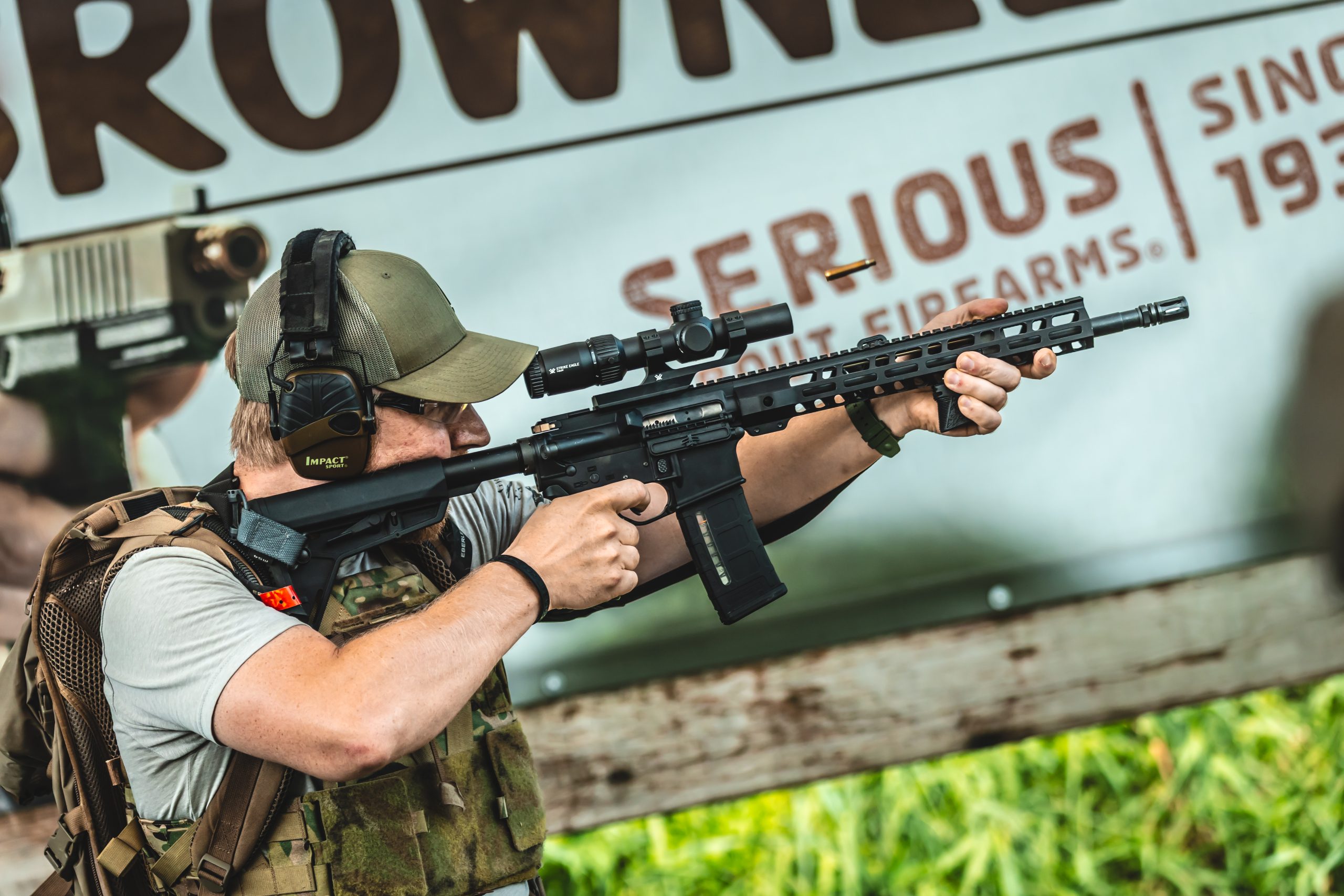
What Happens When CrossFit Meets Competitive Shooting? The Tactical Games.
Ever wonder what happens when you mash up CrossFit, competitive shooting, and 100-degree Iowa heat? You get The Tactical Games. It’s chaos, community, and adrenaline rolled into one. Here’s how my first one went—and almost didn’t happen.
A few years ago, I first started seeing videos about The Tactical Games. I’d been into shooting for years and was really starting to get into fitness as well. So TTG really intrigued me. If you’re not familiar with The Games, think of it as a mix of CrossFit and competitive shooting. Basically, you go out and do something extremely physically exerting, then immediately shoot with an elevated heart rate.


Preparing for the Big Day
There are matches all over the United States. Luckily, there’s one in Iowa every July — Searsboro, to be exact, which is about a three-hour drive from me. I first heard about it in June of ’23, so there just wasn’t enough time for me to get in shape, train, and get the gear I needed. But I decided I was all in for the next year. I told everyone I knew I was planning on doing it — partly to hold myself accountable, and partly so people wouldn’t think I’d lost my mind when they saw me running all over town in a plate carrier. (Yep, you have to wear one while you compete: 15 lbs for men, 12 for women.)
I didn’t know anyone who had ever done it, so I started watching every video I could find, running in my plate carrier to get used to it and dry-firing and shooting whenever I could. I gathered gear and started setting it up in a way I thought would work for me, and got signed up. July came around — and I almost didn’t make it.
I was as ready as I thought I could be. But two weeks before the event, I started feeling awful. No big deal, I told myself. I had two weeks; I’d be fine by then. Then it was a week out — and I still felt like death. My stomach was queasy, I had headaches, and just felt off. But I packed my gear and hoped for the best. Yeah, yeah, I know what you’re thinking: why didn’t you just go to the doctor? I was always one of those guys that only went when he was positive he was dying, and I wasn’t there yet. I’ve since changed my ways a bit in my self-improvement journey, but I digress.


The Event Begins
The Games are a Saturday-Sunday event. The safety brief — mandatory for everyone — is at 6 a.m. each morning. Across the two days, there are eight stages. Each stage is a different event, anywhere from a few minutes to half an hour long. Some are purely shooting, but most combine shooting with physical tasks — often involving sandbags — designed to exhaust you, spike your heart rate, and push you to your limit. Then you shoot again, either with a pistol, rifle, or both. Saturday usually runs until 6 or 7 p.m., and Sunday you do it all again.
Keep in mind: this is July. In Iowa. In the middle of a cornfield. (Technically not, but close — Big Springs Shooting Complex is awesome.) I’d been feeling terrible for two weeks. Friday rolled around — the day I was supposed to leave. My hotel was booked, everything was packed, but I still felt like trash. I had worked too hard to back out, so I put it out of my mind and went anyway. I figured I’d make the call in the morning.
The alarm went off at 4:30 a.m., and I still felt the same. But I’d come too far to quit. I told myself, “You’ve powered through for two weeks — what’s another two days?” The forecast called for 95 and 96 degrees that weekend. How bad could it be?
Anyway, enough of my pity party. Let’s get to the actual event. The first thing I noticed when I pulled in was Tent City — a massive patchwork of canopies where spectators and competitors hang out during downtime. There were hundreds of people — competitors, families, and friends — and the sense of community was immediately obvious. Everyone was helpful. People offered to help set up tents, share advice, or (in my case) explain how the squad matrix worked — that’s the sheet with your number on it that tells you where to be all weekend.
You’re grouped with four other competitors in a squad, and you run each stage together all weekend. When you don’t know a soul, it’s an awesome way to meet people and build camaraderie. There’s nothing like “embracing the suck” together to form bonds fast.


Intensity of the Stages
Some events have multiple firing lanes, so you compete side by side; others are one at a time. That first year, I was surprised at how intense it was. This isn’t a USPSA match you can stroll into and expect to do alright. This event is designed to grind you down — physically and mentally — and show you what you’re made of. If your only “training” is standing at the range shooting paper targets with a resting heart rate, do you really think you’re prepared to defend your life — or, God forbid, your loved ones — in a high-stress, exhausting situation? The Tactical Games won’t replicate that perfectly, but it’s definitely getting there.
I’ve always been fairly fit, but that first year kicked my butt. The heat never bothered me too much — when I’m competing, I’m locked in on the task at hand. The same went for how I felt. Sometimes you just have to grit your teeth and push through. I didn’t start feeling better until the next week, but I don’t think it affected my performance much. I was still surprised by how demanding it was — and I loved it. There’s nothing better than finding out what you’re actually made of.
There’s a fair amount of downtime at these events — time to nap, read, or meet new people around Tent City. Every competitor has at least two guns: a rifle (usually an AR) and a pistol. When you’re not competing, they’re under your tent, so walking through Tent City feels like wandering through a giant armory. Guns, ammo, gear, and plate carriers everywhere. But everyone looks out for each other — if you’re away, your neighbors keep an eye on your stuff and vice versa. That’s pretty darn cool.
Competing and Results
There are several different classes to compete in. Check them out here. I’ve competed in Intermediate both years. That first year, I finished right in the middle of the pack, which I was thrilled with. I’d never done anything like it before, didn’t know a soul, and still went down there, worked my butt off, and beat half the field. No complaints.
Needless to say, I was hooked. So of course I went again this year — and it was a different story. I knew what to expect. I knew how to train, what weaknesses to address, what gear changes to make — and that a wagon is a necessity (trust me). I also brought my girlfriend this time. It’s amazing how much having someone there to support you changes the experience.
This year, I trained harder, smarter, and was in much better shape — and it paid off. I finished 16th out of 59 competitors. I was super happy with that. I know where I need to improve next year, and I know where I have real strengths.
Final Thoughts
There’s a lot to be said for being content — and I am. But there’s always room to grow. Next year, I’m aiming for the top 3. I know it’s possible, and I’m going to work my butt off to get there. Hopefully you’ll join me in this game. It’s intimidating, and yes, it’s a big investment of time and money. But I promise you this: it’s worth it.
If you’re interested, feel free to reach out — I’ll help however I can. Check out TTG’s page for new competitors.
~Sam

You must be logged in to post a comment.